Erasmus+, Klíčová Akce 1: výměna mládeže
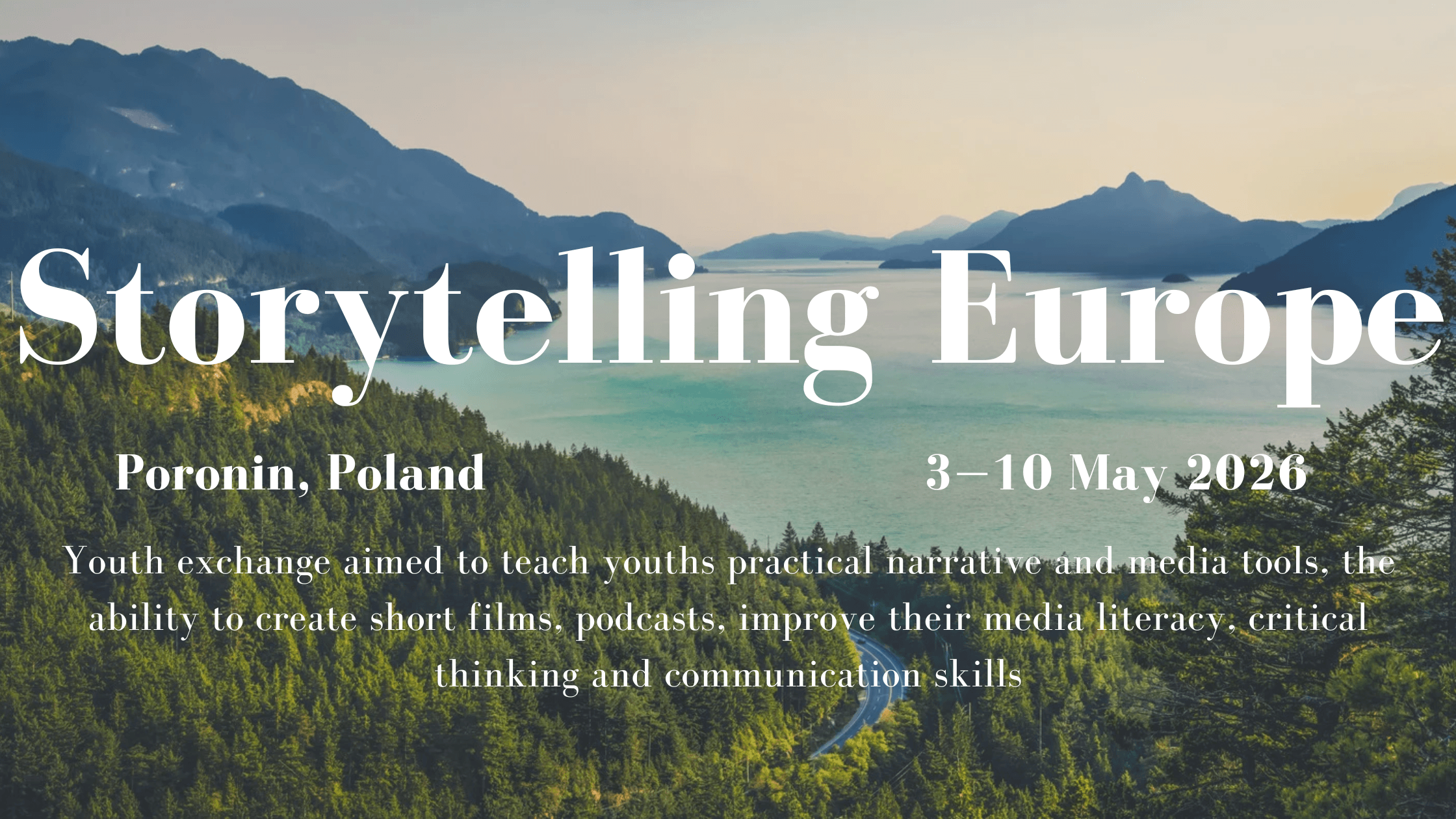
Termín konání: 3.—10. květen 2026
Místo konání: Poronin, Polsko
Český tým: 12 účastníků (ve věku 18-30 let) + 1 group leader (ve věku 18+)
Před tím, než se přihlásíte na jakýkoliv náš projekt, důkladně si přečtěte všechny informace v sekci Chci vyjet na projekt a seznamte se s Pravidly účasti na zahr. projektech.
Prosím důkladně si přečtete info-pack. Pokud máte zájem se na tento projekt přihlásit, prosím odešlete vyplněnou přihlášku co nejdříve.
Pro to, abyste se na tento projekt přihlásili je nutné, abyste vlastnili nejen občanský průkaz (který musíte mít ze zákona), ale také platný cestovní pas (s platností min. ještě 150 dní od datumu začátku vámi vybraného projektu).
V rámci programu ERASMUS+ jsou následující finanční specifika: v rámci všech projektů je kompletně (ze 100%) zajištěno jídlo, ubytování, aktivity, a to vše je zcela pokryto z fondů EU programu ERASMUS+ a zařízeno organizátory. Účastníkům dále budou proplaceny cestovní náklady (reimbursement) z místa bydliště do místa konání projektu a to max. do výše €285/účastník. Pro český tým je možná jen a pouze pozemní doprava (= autobusy, vlaky).
Hostitelská organizace: Fundacja AMBA
Účastnící se země: Polsko, ČR, Řecko
Popis projektu:
Basic skills and key competencies Identity,
citizenship and European values
Quality and innovation in youth work
Objectives
Psychological studies emphasize that the ability to tell one’s own stories and the ability to give meaning to experiences are key mechanisms of identity formation, especially at a young age. For this reason, young people need tools that help them understand themselves, find significance in their experiences, and realize that their voice has genuine value. However, European data show that the voice of young people is still often ignored. Only 37,8% of young people stated that they felt they had an influence on the future of Europe in the review of nine cycles of the EU Youth Dialogue. Furthermore, the Eurobarometer Youth & Democracy 2024 states that voter turnout among people aged 18 to 24 is one of the lowest in the entire EU, despite the increase in political interest. This means that in youth work practice, we need new, attractive, and engaging techniques that correspond to the communication style of Generation Z. Storytelling, both traditional and digital, is the natural language of young people, who use Instagram, TikTok, or podcasts in their daily lives.
The next pressing challenge is disinformation. According to the Eurobarometer, as many as 76% of young Europeans encounter fake news every week, and the Media Literacy Index 2023 places Central and Eastern European countries including Poland, the Czech Republic, and Greece at the bottom of the ranking of resilience to manipulation. From practice, we know that young people often lack tools for critical content analysis. UNESCO and OECD emphasize that the best method of building resilience is not passive analysis but the active creation of one’s own narratives, which allows young people to understand mechanisms of persuasion from the inside and to more easily recognize manipulations. For this reason, we believe that our project is necessary for young people.
We must also not overlook soft and professional skills. According to studies conducted by employers and the OECD, young people, in addition to obtaining diplomas, should develop skills such as creativity, teamwork, communication, and self-presentation. Storytelling combines all these elements, since it requires creativity, group cooperation, courage to speak out, and the ability to present convincingly. Storytelling Europe aims to generate benefits on three levels: at the individual level development of learning outcomes, i.e. competences, attitudes, self-efficacy; at the socio-civic level youth voice, agency, belonging; and in the form of useful results and pathways after the project.
Objectives of our Storytelling Europe:
Strengthening the participation of young people in the democratic and social life of Europe through the development of narrative, media, and intercultural competences, using storytelling as a tool of non-formal education.
1. Equipping young people with practical narrative and media tools, the ability to create short films, podcasts, and photo reports using publicly available tools.
2. Building resilience to disinformation, developing critical thinking and the ability to recognize manipulation through the analysis and creation of narratives.
3. Strengthening European identity and the sense of community by collecting local stories from different countries and presenting them in the form of a shared digital library.
4. Developing soft and professional competences: communication, teamwork, creativity, self-presentation, and courage in speaking out.
5. Ensuring full inclusivity by involving young people with fewer opportunities through simple tools, mentoring, and financial support.
6. Strengthening social and democratic capital by preparing young people for the role of ambassadors, who will be able to tell the stories of their communities and involve others in them.
Activities
Participant profile:
- age 18-30
- 10 people with fewer opportunities
- strong interest in storytelling
- openness to diversity
- motivation for development
- willingness to participate actively
- need to express oneself and be heard
- interest in social and European topics
Group leader profile:
- age 20+, no upper limit
- strong interest in storytelling and at least basic knowledge of the subject
- experience in working with youth
- communication and mediation skills
- knowledge of the Erasmus+ program and quality standards
- empathetic and supportive attitude
- organizational skills and responsibility
Thanks to such a composition, the project gains authentic diversity and representativeness. Each group will contribute its own specificity, i.e. young people from small towns in Poland, young people with special needs in the Czech Republic, and young social and environmental activists from Greece. Together we will create a community in which differences become a strength, and the exchange of experiences and stories will allow all participants to develop their competences, inspire one another, and feel that they are truly co-creating a European narrative.
Our project is based 100% on methods of non-formal education and learning through experience. We will use, among others:
- integration games and ice-breakers to break barriers and build trust,
- autobiographical storytelling, i.e. stories about oneself and one’s surroundings as a tool of self-awareness,
- work in international teams, where participants will co-create stories in mixed groups, learning to cooperate across differences,
- Oxford-style debate, to develop critical thinking and responses to stereotypes or hate speech,
- simulations and educational games, including fact-checking exercises, recognizing fake news, working with real-life examples,
- artistic methods such as drawing, collage, pantomime, photography, which open a path to expression for those less confident linguistically,
- individual and group reflection, Youthpass, and “the story of my change,” which enable participants to consciously articulate the development of competences.
Learning objectives:
We will build a sense of safety, trust, and community in the international group. We will conduct narrative workshops developing the ability to tell stories, to understand their power, and to take responsibility for the message. We will teach media literacy and demonstrate the (non)patterns of critical thinking, i.e. how to recognize manipulation and fake news, and how to create reliable, ethical content. We will introduce narratives about Europe and climate, that is, reflections on shared European identity and the role of young people in responding to the climate crisis. We will develop soft skills, including teamwork, creativity, intercultural communication, and psychological resilience. We will also disseminate results, preparing young people for the role of project ambassadors and creators of local events after their return.
Examples of the activities:
- Intercultural bingo
- Speed-friending
- How can stories change the world?
- Storytelling for leaders: how to inspire a group?
- Stories from the internet: analysis of online narratives
- Intercultural communication through stories
- How to tell your story in a professional context?
- The story of a place: how local history becomes global
- Europe of my dreams: civic storytelling
- Climate stories: how to talk about the environmental crisis
- My story: exercises in autobiographical storytelling
- Storytelling and fake news: how to fight disinformation?
- Fact or narrative? How to recognize media manipulation
Additionally, our project directly implements the ECM, including:
- Goal 4 Information and constructive dialogue, we teach critical content analysis and the creation of personal narratives,
- Goal 9 Space and participation for all, participants will themselves create dissemination events and follow-up activities,
- Goal 10 Youth-oriented Europe, our young people will become co-authors of the narrative about Europe,
- Goal 11 Cohesive and inclusive societies, through inclusive actions, jointly creating stories that transcend divisions.
Impact
Knowledge:
Participants will learn the fundamentals of story construction, including Campbell’s “hero’s journey” model and Brunner’s elements of narration. They will also discover how stories influence emotions and memory, research conducted by Harvard Business School shows that information conveyed in narrative form is remembered up to 20 times more effectively than bare facts. As a result, participants will increase their knowledge of storytelling. Young people will also learn how to recognize fake news and media manipulation. Eurobarometer studies indicate that 76% of young Europeans encounter disinformation on a weekly basis, and our project provides them with practical knowledge on how to distinguish fact-based narratives from propaganda, thereby acquiring skills in media literacy and critical thinking. Through the exchange of stories from different countries, participants will gain knowledge of the shared challenges of youth in the EU, such as youth unemployment, NEET, migration, and the climate crisis. In Greece, for example, the NEET rate reaches 14.8% in Poland, media competences are declining (22nd place in the Media Literacy Index 2023) while in the Czech Republic, the role of inclusive education is increasing. These data will be presented in an accessible and practical way, rather than theoretical, which will translate into increased knowledge of Europe and civil society. Knowledge of digital tools will also be developed, additional training in audio and video editing applications, the use of free programs, and the basics of copyright and GDPR in media work will be introduced during project workshops so that participants may become familiar with and learn to use digital tools. Participants will learn how storytelling can be employed in climate narratives and in the promotion of sustainable behaviors. This is a response to challenges faced in Greece (e.g. catastrophic fires and climate migrations), Poland (e.g. smog and energy transition), and the Czech Republic (e.g. local water crises).
Skills:
Above all, participants will improve their communication competences: the ability to tell stories clearly and engagingly, to deliver public speeches, and to present before a group. For many, this will be the first time they see themselves as individuals capable of speaking publicly and engaging others. Attention will also be paid to critical thinking and the analysis of media content, including source comparison and drawing conclusions. Through work on narration, young people will begin to recognize mechanisms of manipulation, strengthening their resilience to disinformation. Teamwork will also be improved, as the project fosters cooperation: one person may be responsible for the script, another for recording, editing, or promotion. Participants will learn coordination and task distribution, which in turn will translate into creativity and innovation. Storytelling requires a creative approach, seeking new perspectives, and employing various media. These skills are highly valued by employers according to the OECD, 85% of companies expect creativity from young candidates. Foreign language competence is also needed in professional contexts therefore, working in English during the project will develop practical communication skills, particularly in speaking, and will also expand learning abilities. Both linguistic and social skills will be monitored through daily reflection and Youthpass, enabling participants to consciously recognize and articulate their competences.
Attitudes and behaviors:
Above all, participants will develop a sense of agency: young people will see that their voice matters. By creating and presenting films or photographs, they will experience that they can influence their environment and be heard. Intercultural openness will also increase: through meetings with peers from the Czech Republic, Greece, and Poland, participants will realize that cultural differences are a source of richness, while their everyday problems are often similar. This strengthens the sense of European community and builds inclusivity and empathy. Working in groups with youth from different backgrounds fosters tolerance, empathy, and solidarity, and expands European and civic responsibility. Participants will themselves understand that being European is not only a right but also a duty for example, participation in public debate, combating disinformation, caring for the environment and for society. We will therefore also raise ecological awareness: participants will become more sensitive to climate and environmental issues and will understand how their everyday choices are connected to global problems.
Competence leap:
- Narrative and communication, we will work on story structure, voice, and conclusion, and practice performance exercises.
- Digital and media, through planning, recording, and editing short films (2-4 minutes), critically reading narratives, and distinguishing emotional appeals from facts.