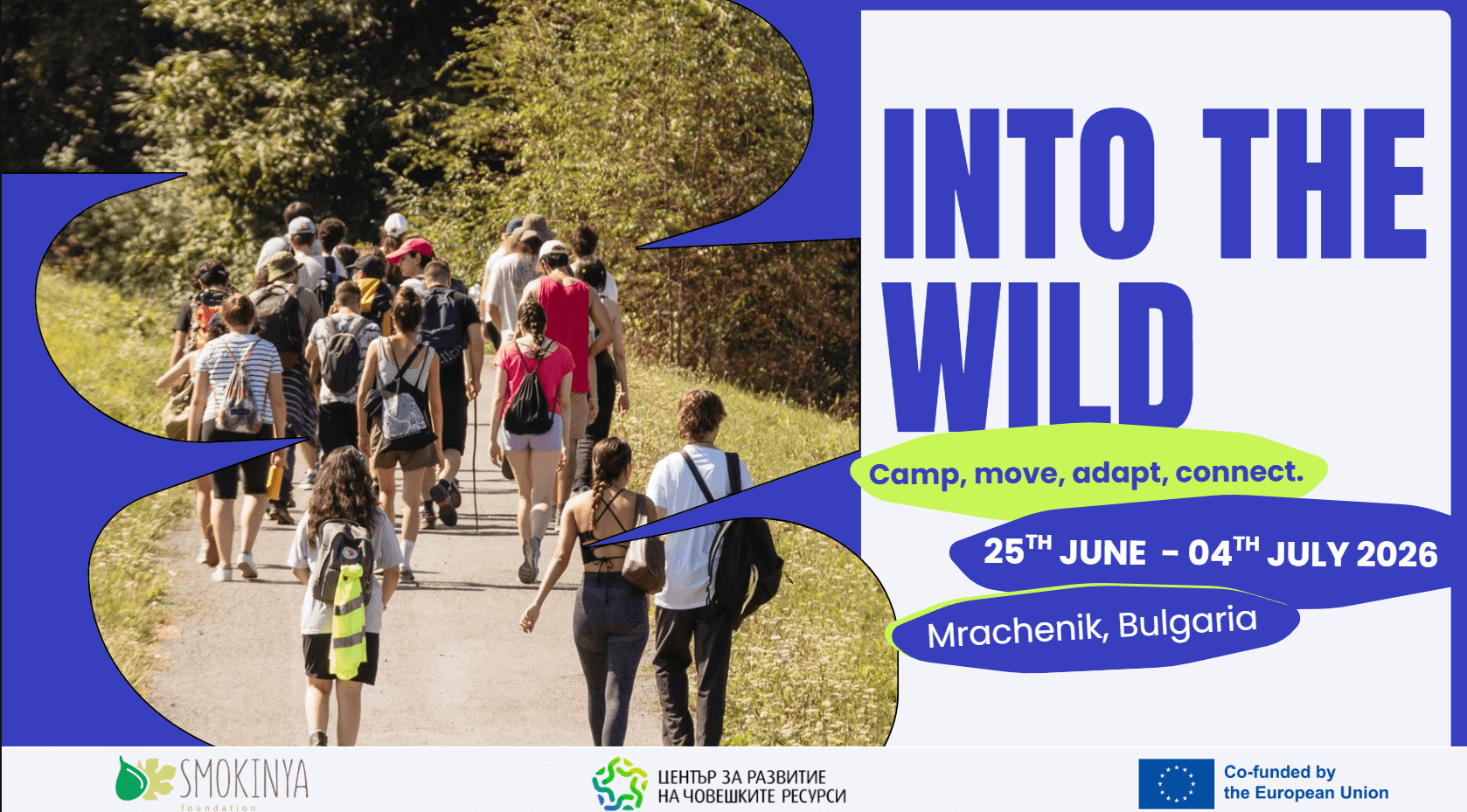
Into the Wild — Bulharsko

single-image

Erasmus+, Klíčová Akce 1: tréninkový kurz 

Termín konání: 25. červen—4. červenec 2026

Místo konání: Mrachenik, Bulharsko

Český tým: 2 účastníci (ve věku 18+)

Před tím, než se přihlásíte na jakýkoliv náš projekt, důkladně si přečtěte všechny informace v sekci Chci vyjet na projekt a seznamte se s Pravidly účasti na zahr. projektech.

Pokud máte zájem se na tento projekt přihlásit, prosím důkladně si přečtete info-pack. Pokud máte zájem se na tento projekt přihlásit, prosím odešlete vyplněnou přihlášku co nejdříve.

Pro to, abyste se na tento projekt přihlásili je nutné, abyste vlastnili nejen občanský průkaz (který musíte mít ze zákona), ale také platný cestovní pas (s platností min. ještě 150 dní od datumu začátku vámi vybraného projektu).

V rámci programu ERASMUS+ jsou následující finanční specifika: v rámci všech projektů je kompletně (ze 100%) zajištěno jídlo, ubytování, aktivity, a to vše je zcela pokryto z fondů EU programu ERASMUS+ a zařízeno organizátory. Účastníkům dále budou proplaceny cestovní náklady (reimbursement) z místa bydliště v ČR do místa konání projektu dle způsobu dopravy:

  • €309 v případě letecké dopravy,
  • €417 v případě pozemní dopravy (= pouze autobusy/vlaky),

Hostitelská organizace: Smokinya Foundation

Popis projektu:

Into the Wild is the third and culminating training within the Smokinya Academy Trilogy. It is an immersive outdoor learning experience built around camping, hiking, and living together in simple conditions. 

Here, you step away from screens, routine, and everyday comfort, and closer to people, nature, and the present moment. In this rural, wild, retreat setting. Your senses will sharpen, connection deepens, and learning happens through life outdoors.

This training is not about adding more theory. It is about living the experience directly. Less tech, more tents. Less noise, more nature and more real connection.

The core intention is to help you bridge the gap between:

  • knowing and doing
  • awareness and behaviour
  • intention and action

With no script, no predefined correct answer, and no digital buffer between you and the experience, you learn through the way you move, adapt, cooperate, and relate, to yourself, to others, to discomfort, and to the natural world around you.

Pillars of the training:

  1. Self-leadership in reality: Acting consciously under pressure, uncertainty, and discomfort.
  2. Human connection: Building trust, communication, and cooperation without digital mediation.
  3. Action competence: Turning awareness into observable behaviour and practical outcomes.

Key principles:

  • Learning through experience, not instruction
  • Action first, reflection after
  • Discomfort as a catalyst for growth
  • Collective learning through shared responsibility
  • Integration of body, mind, and environment


The project is grounded in non-formal and experiential learning, with a strong emphasis on embodiment, systems awareness, and real-life challenges.

The learning process follows a continuous cycle: Action  Reflection  Integration  Application

Methodology 

This training uses an experiential, non-formal methodology based on action, reflection, shared responsibility, and real-life challenge. Participants learn through direct experience, group dynamics, outdoor conditions, embodiment, and open-ended situations that invite awareness, resilience, and conscious action.

The methodology is based on:
  • learning through experience: action first, reflection after
  • self-directed learning: participants take responsibility for their process
  • embodiment: learning through body, mind, emotions, and action
  • shared responsibility: daily life and group tasks are part of the learning
  • challenge-based learning: discomfort and uncertainty as tools for growth
  • reflection and integration, turning experience into practical learning

Learning outcomes:

Participants are expected to leave the training with:

  • stronger self-leadership and decision-making
  • greater resilience in situations of discomfort and uncertainty
  • improved communication and teamwork skills
  • more awareness of personal habits, reactions, and comfort zones
  • practical experience with experiential, nature-based, and low-digital learning
  • concrete tools to transfer the learning into youth work and community practice

Participants‘ profile:

This training is for open, curious, and committed people who are ready to challenge themselves, step out of routine, and learn through direct experience. It is especially for youth workers, facilitators, educators, NGO staff, and active volunteers (18+) involved in youth work, non-formal education, or community development.

This training is for people who are:

  • interested in outdoor activities and nature-based learning
  • ready for the challenge of camping and low-comfort conditions
  • open-minded, motivated, and willing to take initiative
  • emotionally and mentally prepared for an intensive group process
  • willing to take responsibility for themselves and for the group
  • comfortable with uncertainty, flexibility, and learning without a fixed script
  • ready to participate actively, not passively
  • available for the full duration of the project

The venue:

Into the wild takes place in the rural village of Mrachenik, Bulgaria, in the Bright Future Training Center, a partially restored abandoned school, under low-comfort, semi-off-grid conditions.

Participants will experience:
  • accommodation in shared tents (2–3 people)
  • basic sanitary facilities (shared showers, Balkan-style toilets)
  • limited access to digital connectivity
  • remote location (nearest urban area approx. 25 km away)

These conditions are not logistical limitations, but intentional elements of the methodology. By stepping away from comfort, routine, and constant digital stimulation, participants are invited into a space where learning becomes more immediate, embodied, and real.

The environment supports:
  • presence and focus
  • reduced external stimulation
  • authentic human interaction
  • confrontation with personal habits and comfort zones

Follow-up:

Participants are expected to support the promotion of Erasmus+ programme and the youth opportunities by implementing follow-up activities.

  • Online follow-up call one month later to support local action implementation. 
  • Time for action: participants organize small-scale reflection or volunteering events in their home communities. 
  • Dissemination through events, presentations, workshops and reaching 10 other local youth.
  • Smokinya’s website, blogs, and social media, as well as on websites and social media of partner organisations.

Funded by the European Union. Views and opinions expressed are however those of the author(s) only and do not necessarily reflect those of the European Union or the European Education and Culture Executive Agency (EACEA). Neither the European Union nor EACEA can be held responsible for them.

Možná se ti bude líbit